Modern Intrusion Detection Systems (IDS) face severe challenges due to heterogeneous network traffic, evolving cyber threats, and pronounced data imbalance between benign and attack flows. While generative models have shown promise in data augmentation, existing approaches are limited to single modalities
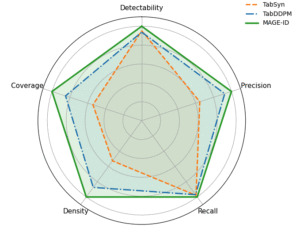
and fail to capture cross-domain dependencies. This paper introduces MAGE-ID (Multimodal Attack Generator for Intrusion Detection), a diffusion-based generative framework that couples tabular flow features with their transformed images through a unified latent prior. By jointly training Transformer and CNN-based variational encoders with an EDM style denoiser, MAGE-ID achieves balanced and coherent multimodal synthesis. Evaluations on CIC-IDS-2017 and NSL-KDD demonstrate significant improvements in fidelity, diversity, and downstream detection performance over TabSyn and TabDDPM, highlighting the effectiveness of MAGE-ID for multimodal IDS augmentation.
References:
M. A. Loodaricheh, M. H. Manshaei and A. Raja, “MAGE-ID: A Multimodal Generative Framework for Intrusion Detection Systems,” Proceedings of 2026 International Conference on Computing, Networking and Communications (ICNC), Maui, HI, USA, 2026, pp. 585-589, (26% acceptance rate) doi: 10.1109/ICNC68183.2026.11416962.[arXiv]
M. A. Loodaricheh, N. Majmudar, A. Raja, and A. Salleb-Aouissi, “Handling Uncertainty in Health Data using Generative Algorithms,” Poster at the Workshop on Large Language Models and Generative AI for Health at AAAI 2025, March 2025, Philadelphia.

This entry is licensed under a Creative Commons Attribution-NonCommercial-ShareAlike 4.0 International license.

